

How do you keep a global construction-equipment supply chain on time when demand shifts faster than the plan? That was the question for the SUGAR team at the Product Development Research Lab, which worked with Volvo Construction Equipment from January to June 2026 on advanced analytics and AI for demand forecasting and decision-making.
The challenge
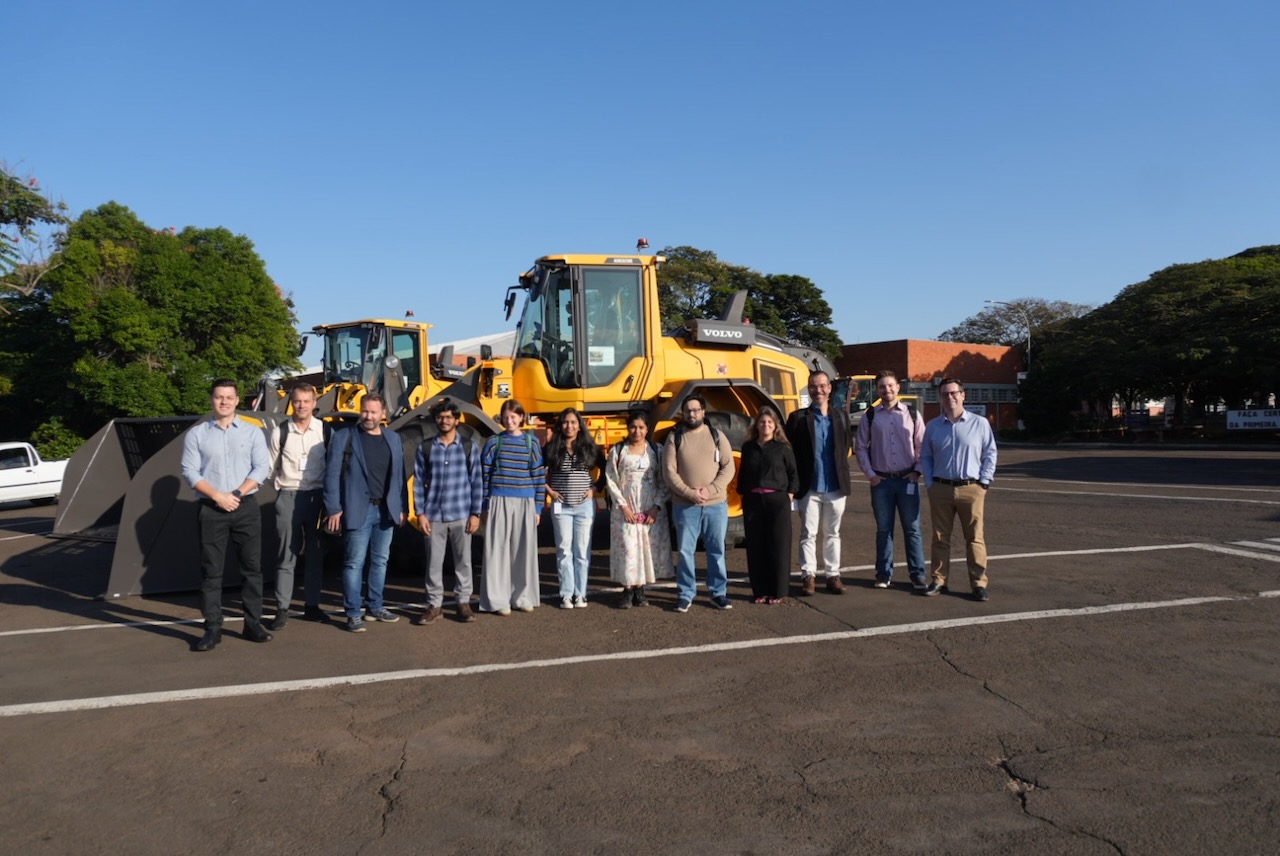
Once again, BTH students joined a SUGAR project with a team that combined Software Engineering and Mechanical Engineering students, with skills in AI and machine learning. They collaborated with master’s and PhD students in AI and Design from the University of São Paulo (USP).
Volvo CE’s challenge centred on two connected processes, S&OP (Sales & Operations Planning) and S&OE (Sales & Operations Execution). Both concern customer demand, but also the internal customers in production, who must prepare and plan to put that demand through the production lines. A small and a large machine of the same type can follow similar lines yet place very different demands on production capacity, so getting the demand picture right matters well beyond the sales organisation.
The brief asked two questions. First, how can advanced analytics (statistical, predictive and optimisation models) be combined with AI (machine learning, intelligent agents and generative AI) to improve demand forecasting and reduce errors? Second, how can intelligent decision assistants support S&OP and S&OE meetings by simulating scenarios, monitoring risks in real time and proposing actions that improve key indicators?
The team focused on the information that can be developed to support these processes, such as forecasts and the factors behind them. How people make the decisions in the planning meetings was outside the scope of the project.
From problem to prototype
The team followed the regular SUGAR cycle: problem scoping, needfinding and defining a point of view. They then moved into prototyping, developing advanced prototypes that address the issue.
The team
The BTH team consisted of Venkata Sai Abhiram Akula, Vaishnavi Bojja and Jyothi Madhurya Nalam, master’s students in Software Engineering with skills in AI and machine learning, together with Imel Rahman, who studies the Master of Science in Engineering programme in Mechanical Engineering. They worked closely with USP colleagues Davi Fileti and Bruno Figueiredo, both PhD students in AI, and Sara Cattaneo, a master’s student in Design. It was an integrated team, and the split between the solutions mainly reflected each member’s specialisation.
What the team delivered
The team’s main deliverable is a demand forecasting dashboard for Volvo CE Brazil. It presents machine learning forecasts to support the S&OP process, so the numbers can be used in the planning conversation itself. The forecasts draw on weak signals such as material prices and global events, including conflicts. The team used these signals to train models that gauge how they affect demand, which product configurations customers are likely to want, and the volumes of investment they foresee. The forecasts are updated at set intervals during the year, each time drawing on current snapshots of the underlying data. Following the weak signals across these updates adds knowledge and helps manage uncertainty in the period leading up to the point where orders are locked in. The team tested the dashboard’s output against actual demand using historical data. Early results are encouraging, though further testing is needed.
The dashboard also includes an alternative view based on Predictive Mechanical Health Modelling (PMHM), developed by Imel Rahman as part of a master’s thesis and using articulated haulers as a use case. Production capacity alone does not show whether a fleet can meet a customer’s requirements over time under demanding conditions. PMHM connects the customer’s work to simplified information about mechanical health, so planners and salespeople can see how many machines of which size a job needs. It presents fleet capacity together with factors such as remaining useful life, cost, fuel consumption, and CO₂ emissions, which makes the reasons behind different fleet configurations easier to understand. This view is not yet fully integrated with the forecasting views. It is an assumption-based proof of concept, and its results are scenario-based estimates rather than validated predictions. Taking it further would need measured operating data and validation against real machines. In the longer term, it could connect with dealer stock planning, forecasting, and manufacturing.
“Volvo CE found the approach interesting and sees it as worth exploring further.” says Martin Frank, Senior Specialist at Volvo CE.
The work was developed as part of SUGAR Project 2026, the collaboration between BTH, USP and Volvo CE.
Why it matters
Forecast errors become surplus stock, missed deliveries or expensive expediting. Forecasts that are revisited as conditions change let planners see risk building before orders are locked in. For products offered in many configurations, forecasting the mix matters as much as forecasting the total volume. For our students it was also a chance to work on an industrial problem with real stakes. The next step is a deeper dialogue with Volvo CE on how these ideas could be developed and tested against real operating and planning data.
We thank Volvo Construction Equipment for a challenging brief, our colleagues and students at the University of São Paulo, and the SUGAR network for making the collaboration possible.

